

Caroline Nguyen is a UTMB medical student.
A note from the author(s): This piece serves as a reflection on one of the most formative experiences in my professional development as a medical student/budding psychiatrist, occurring during my third-year psychiatry clerkship. A violent outburst from a patient served as an example of how providers should afford even their most difficult patients patience.
As early as upon admission to the behavioral health hospital, a psychotic young man “Alex” made himself known by sneering at female patients, asking them for “conjugal visits”. A male patient who witnessed this harassment confronted him, saying that his behavior was inappropriate and unacceptable; later that day Alex charged toward this patient in the common area and jumped him. Throughout daily pre-rounding during his hospital course, he insisted on being discharged to his home the FBI provided for him due to him being an alien under their watchful protection. His facial expressions ranged from an uncanny, inappropriate smile to a murderous, unsettling glare. He was certainly the most acutely ill patient managed by our team.
One morning, Alex attacked another patient who merely beckoned him from the common lounge area to the cafeteria for their scheduled breakfast. He was then sent to his room under one-to-one supervision but continuously asked to be sent to jail for this incident. During rounds, our team’s attending psychiatrist stood at the doorway of Alex’s room, trying to gather insight as to why he would rather be in jail than here (the behavioral health hospital) where he could receive help. The patient, with vast experience in and out of the legal system, was adamant that jail was better suited for him and that from there he just wanted to go home. The physician reassured him that we were on his side and that we also wanted him to go home but only after he was well [through adequately controlling his psychotic and aggressive symptoms]. Still, Alex insisted that he wanted to go to jail. This conversation continued for a few minutes this way, making no progress one way or the other, until suddenly Alex lunged at the attending psychiatrist trying to punch him. Since this occurred in the blink of an eye, I did not see whether the hit landed, but our agile attending physician stepped backward. An equally agile resident physician on the team held Alex’s wrists to restrain him, to which Alex spat in his face. Soon after, nearby patient care technicians rushed over to contain the situation and keep the patient in his room to calm down alone. After directly witnessing Alex’s attack on the physician working so sincerely and devotedly to treat him, I realized just how little insight he had due to his psychosis and how much he direly needed to stay at the hospital for treatment.
We learned through collateral information provided by Alex’s mother that he used to be a “good boy” who worked at a bakery and drove himself around independently before getting involved with the wrong crowd. His extensive legal history began at this time when he began breaking and entering. While incarcerated for one of his crimes, Alex was relentlessly gang-raped by fellow inmates, around the onset of his first psychotic symptoms. He was then admitted to a state psychiatric institution, where his psychosis was so persistent, severe, and refractory that he was hospitalized for about a year before his illness was finally controlled. After discharge, his mother believed him to be over-medicated and took him off of this drug. Subsequently, his psychosis reawakened and led him down a path of more legal issues and eventually, this behavioral health hospital where we encountered him. Although his life story before it devolved remained somewhat unclear, we could only assume it was riddled with tragedy and hardship, such as his mother divulging that she cheated on Alex’s father with a boyfriend, and the boyfriend ultimately murdered his father.
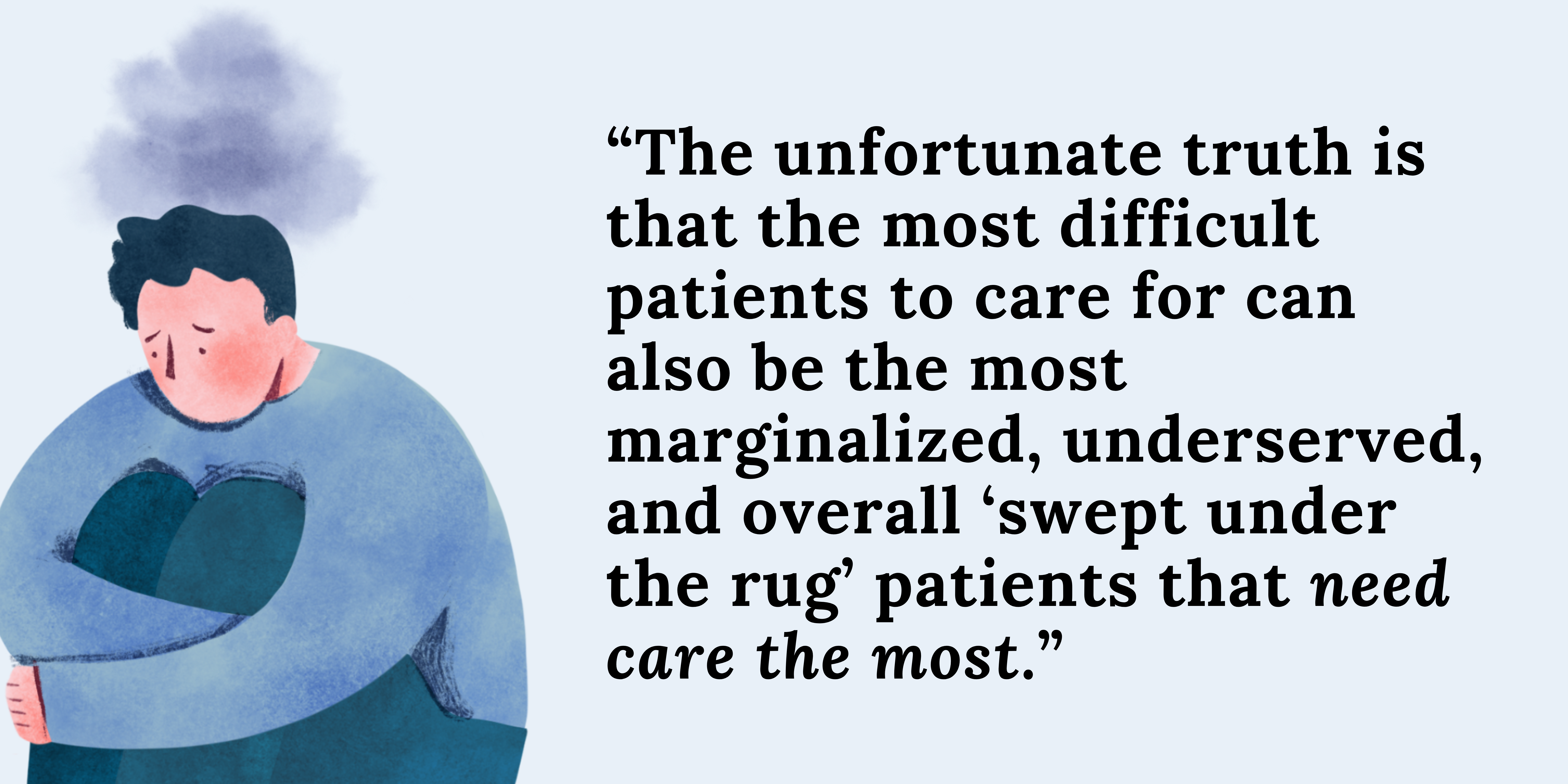
The unfortunate truth is that the most difficult patients to care for can also be the most marginalized, underserved, and overall “swept under the rug” patients that need care the most. Surely there is a reciprocal relationship between Alex’s circumstances and mental illness, where worsened circumstances led to worsened mental illness and so forth. He lacked the insight to understand this cycle, as his incarcerations were marked with trauma significant enough to trigger psychosis, yet he preferred to go back to jail over receiving psychiatric care due to its pervasive familiarity. Despite Alex’s psychosis and aggression that culminated in attacks on other patients and even the physicians caring for him, his treatment team remained dedicated to treating him as the human being he is. The attending psychiatrist refused to “wipe his hands clean” of Alex by acquiescing to his request of sending him to jail but instead continued to provide treatment thereafter. Neither he nor the resident physician who was spat on pressed charges or even entertained the thought of doing so. I admired the relentless respect and patience our attending psychiatrist gave Alex, as he did to all of his patients, no matter how difficult they were to manage. As the medical student on the team who witnessed this violent outburst and was involved in his care, my resolve to pursue psychiatry was strengthened, as psychiatric patients are often dismissed as the “crazies” no one else wants to deal with, despite suffering from legitimate disorders. I saw our attending psychiatrist as the steadfast healer I wanted to become in the future, and Alex, like other difficult patients, as a severely ill human being whose care simply required more patience.
 Medical Humanities & Arts Anthology
Leave a comment