

Shirley Chan Sanchez, Michelle Chan Sanchez, and Liliana Pellegrini are UTMB medical students.
Note from the author(s): Although this piece is from a personal narrative, writing it was a team effort. The other authors were Michelle Chan Sanchez and Liliana Pellegrini.
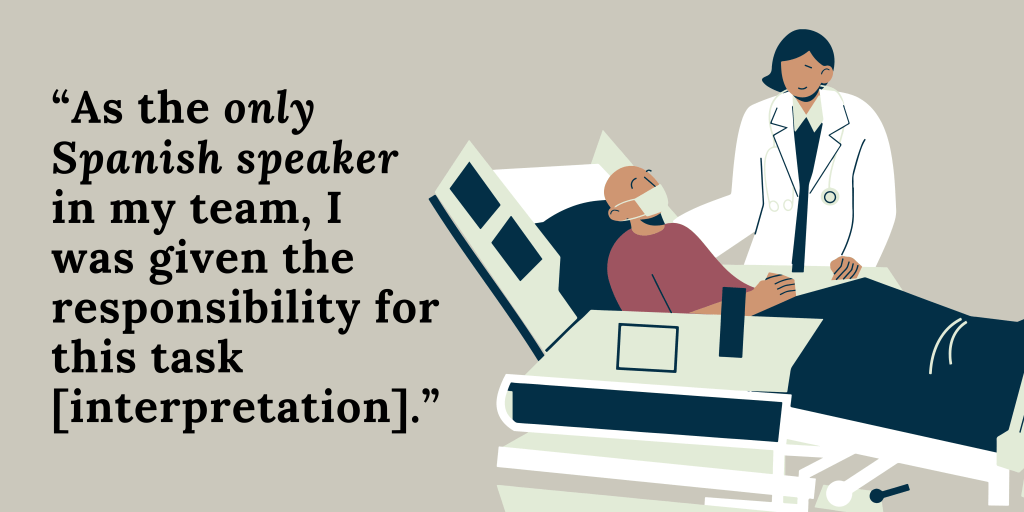
Language barriers are known to pose a significant impact on health outcomes for limited English proficiency (LEP) patients. I had a Spanish-speaking patient with a PMH of HIV with suspicion for cryptococcal meningitis, which would require a lumbar puncture to diagnose. Usually with these types of encounters, the team looks to a member who is Spanish speaking to interpret for the encounter. As the only Spanish speaker in my team, I was given the responsibility for this task. I was not comfortable in doing this task as I have not been trained in medical Spanish to allow me to explain how a lumbar puncture works. Furthermore, I felt inadequate in my translation of the information since I—myself, a student just starting their clinical training—barely understood how the procedure was to be performed. Not only did I feel that I must obey what I’m told, but I was pressured to impress those above me. I was not sure at the time if this was the right thing to do, so I did some investigating surrounding language barriers and informed consent.
Language barriers are mostly addressed in the primary setting but much less frequently in the secondary or tertiary level of care where procedures are prominent.1 It becomes a more pronounced issue when having to speak to patients during informed consent regarding their procedures. The literature shows that physicians tend to prefer ad hoc interpreters, which are Spanish speaking staff members, the patient’s family members, or any of their own team members who speak Spanish over using an interpreter line because it can speed up the process of starting the procedure rather than finding and waiting on interpreter lines.2 Ad hoc interpreters all have some bias on what they would like to highlight or disregard when translating, which creates an unconscious gap between the provider and the patient.2 Although the use of ad hoc interpreters may seem like an efficient manner to complete documentation for informed consent, none of these ad hoc interpreters are trained in medical Spanish, which can hurt the patient in the long run.3 The consequences of not using interpreter lines for LEP patients include longer hospital stays, higher costs, unnecessary work ups, over- or under- treatment with opioids, and loss to follow-up.3
There is also a lack of completed informed consent documentation for patients with limited English proficiency due to insufficient training on how to obtain informed consent for this specific population. A lack of knowledge in using interpreter lines and pressures from faculty to get these tasks done quickly further adds to the problem of insufficiently informed consent.4 There are already federal and hospital policies in place regarding using interpreter professionals for certain situations. In certain hospitals, it is required that an interpreter is used for patients who do not speak English where providers may be marked if the use of an interpreter is not documented on the electronic medical records.2 Although these policies are placed, there are discrepancies in their implementation, and often, they are ignored or incompletely adhered to. Additionally, patients themselves tend to prefer using their own family members or anyone on staff that is Spanish speaking since people with similar culture affiliations tend to make the patients feel more comfortable.5 This then becomes a hard issue to address since there seems to be no group siding with using a trained interpreter.
There are various solutions to this problem; enforce federal and hospital policies regarding the use of interpreter lines for informed consent; educate trainees and medical students on the importance, benefits, and safety that patients can obtain from having an adequate informed consent discussion; and train staff members on not only cultural competency, but also how to use interpreter services correctly. To address patient interaction, it has been shown that using videos, PowerPoints, and other visuals in addition to interpreters helps them further understand the details of the procedure as well as increases patient trust and satisfaction.6 However, this may not fully replace the comfort they may feel with having an in-person Spanish speaker who is culturally similar to them. It is therefore important to utilize staff skillsets and fluency in other languages to express to patients the need to bring on trained interpreters as part of their care team. Moving forward, this would be a way in which to make the whole healthcare team work more synchronously.
Reflecting back to my own part in this problem, I find that although I was pressured to seem educated and willing to take initiative during this experience, I now know that it is far more important to focus on the patient’s long-term treatment and healthcare outcomes. This first requires for me to advocate for myself as a Spanish- speaker who is given the burden to have to interpret for all Spanish-speaking patients while having very little medical knowledge. Now that I know have the knowledge of why having myself or somebody who is not professionally trained can be harmful to patients, I should advocate for myself. It is important for myself and other multilingual students to take on this role of advocacy in informed consent settings, for the sake of ourselves and our patients.
References
- Joo, H., Fernández, A., Wick, E. C., Lepe, G. M., & Manuel, S. P. (2023). Association of Language Barriers With Perioperative and Surgical Outcomes: A Systematic Review. JAMA Network Open, 6(7), e2322743-e2322743.
- Patel, D. N., Wakeam, E., Genoff, M., Mujawar, I., Ashley, S. W., & Diamond, L. C. (2016). Preoperative consent for patients with limited English proficiency. Journal of surgical research, 200(2), 514-522.
- John-Baptiste, A., Naglie, G., Tomlinson, G., Alibhai, S. M., Etchells, E., Cheung, A., … & Krahn, M. (2004). The effect of English language proficiency on length of stay and in-hospital mortality. Journal of general internal medicine, 19, 221-228.
- Schenker, Y., Wang, F., Selig, S. J., Ng, R., & Fernandez, A. (2007). The impact of language barriers on documentation of informed consent at a hospital with on-site interpreter services. Journal of General Internal Medicine, 22, 294-299.
- Jaramillo, J., Snyder, E., Dunlap, J. L., Wright, R., Mendoza, F., & Bruzoni, M. (2016). The Hispanic Clinic for Pediatric Surgery: A model to improve parent–provider communication for Hispanic pediatric surgery patients. Journal of Pediatric Surgery, 51(4), 670-674.
- Clark, S., Mangram, A., Ernest, D., Lebron, R., & Peralta, L. (2011). The informed consent: a study of the efficacy of informed consents and the associated role of language barriers. Journal of Surgical Education, 68(2), 143-147.
 Medical Humanities & Arts Anthology
Leave a comment